


You’re Not Clenching Your Teeth Because You’re Stressed
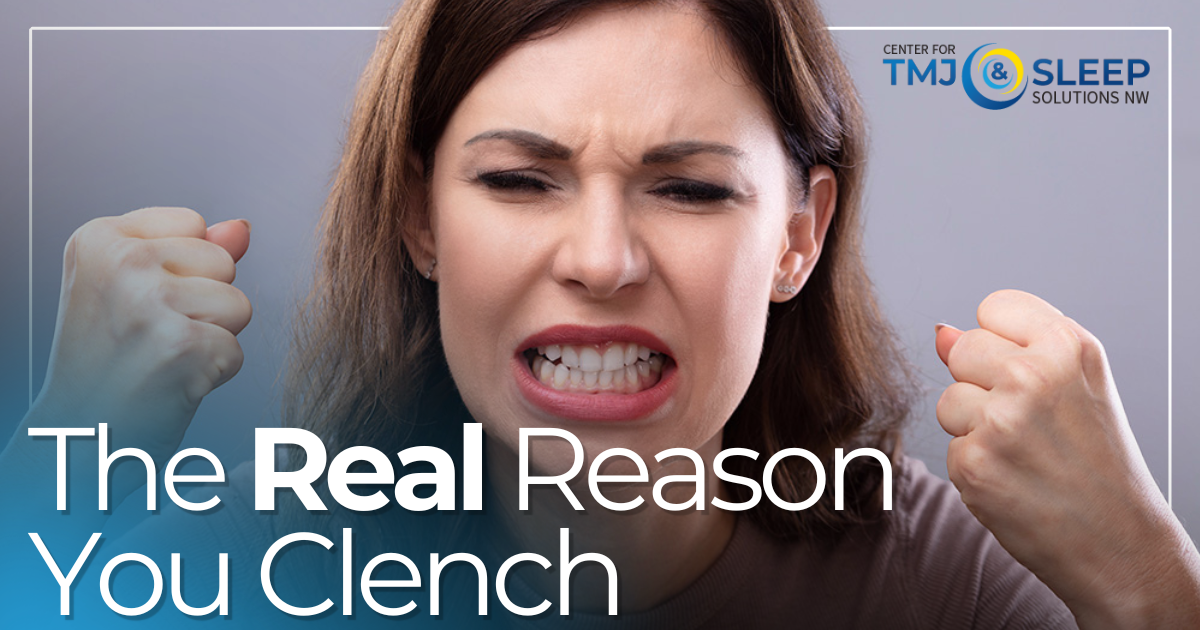
Most people are told the same story when jaw pain or clenching shows up: You’re stressed, and you need to relax. That explanation sounds reasonable, but it often misses what is really happening. For many patients, clenching is not caused by stress. It’s the driver of it. Continue reading to learn why.
The Real Cause Behind Jaw Clenching
During healthy, restful sleep, your body downshifts. Muscles relax, breathing becomes slow and steady, and your nervous system settles down. For some people, that process is disrupted because of sleep-disordered breathing.
If your airway narrows or collapses even slightly during sleep, the body responds quickly to protect itself. One of the fastest protective responses is muscle activation. The jaw moves forward, the tongue tightens, and the muscles around the face and neck engage. This helps keep airflow moving, but it comes at a cost. Those muscles are now working all night long, even though you are asleep. You may not realize it’s happening, but your nervous system does. By morning, your body is already activated, causing tension that feels like stress before the day even begins.
Clenching as a Survival Response
This is where the narrative flips. Clenching is not a bad habit or a lack of willpower. It’s often a survival response driven by airway instability and nighttime muscle activity. Your body is doing exactly what it’s designed to do: prioritize breathing. When that happens night after night, the jaw muscles never fully recover. The nervous system stays on high alert. Over time, this can show up as jaw pain, headaches, neck tension, poor sleep quality, and a constant sense of feeling on edge during the day. Patients are often surprised to learn that their stress response may be rooted in physiology rather than personality or circumstances.
Why Daytime Stress Feels So Real
When your muscles have been working all night, your body starts the day already depleted. Cortisol patterns can shift. Pain sensitivity can increase. Small challenges feel bigger than they should. This is not because you are doing anything wrong. It is because your system has not had the chance to fully reset.
Many patients describe feeling wired and tired at the same time. They may wake up with jaw tightness, headaches, or a sense of pressure behind the eyes. By mid-morning, they already feel like they have been pushing through the day. Once clenching and sleep disruption are addressed, many notice that their baseline stress level begins to soften without actively trying to change their mindset.
Why Relaxation Alone Is Not the Answer
Being told to relax your jaw can feel frustrating when your body is clenching unconsciously. Nighttime clenching is not something you decide to do. It’s automatic.
That’s why effective TMJ and sleep-focused care looks beyond surface symptoms. We look at airway space, bite stability, muscle patterns, and how your jaw moves when your body is at rest. When those systems are supported properly, the jaw no longer needs to overwork to protect breathing.
A Different Way to Think About Clenching
If you clench your jaw, it doesn’t mean you’re failing at stress management. It may mean your body has been compensating for something it needs help with. When we address the root cause of nighttime muscle activity, clenching often naturally reduces. This approach replaces blame with understanding and frustration with clarity. When breathing, sleep, and jaw function are properly supported, the body can finally step out of protection mode.
Sometimes, the most effective way to feel calmer during the day starts with what happens while you sleep. Schedule your next appointment with us at one of our locations in Silverdale, WA, Bellevue, WA, and Federal Way, WA.