



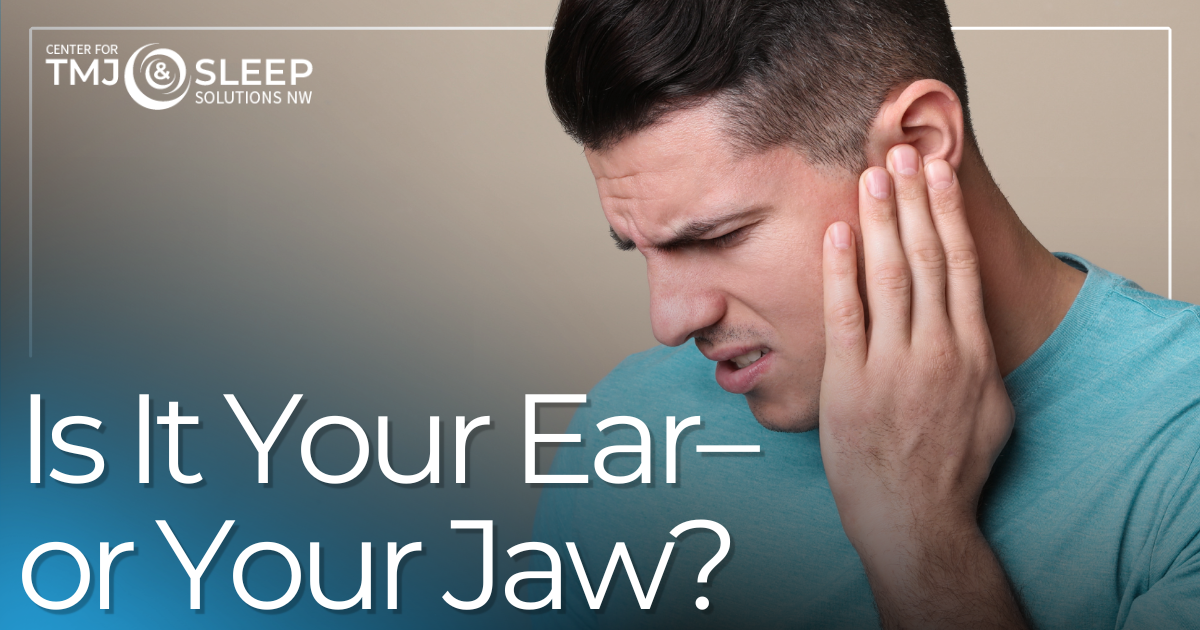
Why Some TMJ Symptoms Feel Like Ear Problems
Ear pressure that will not go away, an aching sensation around the ear, ringing, or a feeling that something just doesn’t seem right: when symptoms feel like they are coming from your ears, it can make sense to assume the ears themselves are the problem. Sometimes they are. In other cases, however, the source of the discomfort may be surprisingly close by.
The Jaw and Ear Are Neighbors
The temporomandibular joints sit directly in front of the ears, connecting the lower jaw to the skull. Problems involving these joints and the surrounding muscles can produce symptoms that patients easily mistake for an ear condition.
Place your fingers just in front of your ears and open and close your mouth. You can feel your temporomandibular joints moving beneath your fingertips. That close anatomical relationship explains why jaw problems can sometimes be experienced around the ear.
What’s TMD Got to Do With Your Ears?
Temporomandibular disorder (TMD) isn’t a single condition. It describes a group of disorders involving the jaw joints, the muscles used for chewing, or both. Symptoms can include:
- jaw and facial pain
- clicking or popping when the jaw moves
- difficulty chewing
- limited jaw movement
- headaches
- ear pain
At Center for TMJ & Sleep Solutions NW, ear pain is one of the symptoms we see in patients with TMD. Some patients also experience symptoms such as ringing in the ears, dizziness, or changes in hearing. These symptoms aren’t proof of TMD, but they can certainly be related and are worth investigating further.
TMD Symptoms Can Be Confusing
Ear symptoms do not always point neatly to one condition. An ear infection or another ear problem may cause an earache. Ringing can have a number of possible causes. Fullness, pressure, dizziness, and hearing changes can also have explanations unrelated to the jaw. Therefore, assuming that TMD causes every ear symptom is just as problematic as assuming that TMD could never be the issue.
If an ear problem doesn’t explain the symptoms, or if ear discomfort occurs along with jaw-related symptoms, looking at the temporomandibular joints can provide another piece of the puzzle. One clue is that discomfort changes with jaw movement. If pain increases when you chew, open your mouth, or move your jaw, that information could point toward a jaw-related source.
Diagnosis Comes Before Treatment
TMD treatment should begin with understanding what is actually happening. A thorough evaluation considers your symptoms and the way your jaw is functioning. Depending on what the evaluation reveals, additional diagnostic information may also be needed. The goal is to develop a clearer picture of the source of the problem before deciding which treatment approach makes sense.
Finding the Right Place to Look
If you have been dealing with unexplained ear discomfort, particularly when it occurs along with jaw pain, headaches, clicking, tension, or difficulty chewing, the jaw may be worth considering as part of the evaluation. That does not mean TMD causes every ear symptom. It means that getting the right diagnosis may require looking at all of the possibilities rather than focusing only on where you feel the discomfort.
If you would like to learn whether TMD could be contributing to your symptoms, schedule an appointment with our offices located in Silverdale, Federal Way, and Bellevue, WA. At Center for TMJ & Sleep Solutions NW, we will carefully evaluate your symptoms, look for the underlying cause, and help you understand the next appropriate step.